
Chronic knee pain—especially from osteoarthritis or injury—can significantly impact your mobility and quality of life. As more patients look for alternatives to surgery, regenerative medicine treatments like Platelet-Rich Plasma (PRP) and Bone Marrow Concentrate (BMC) have gained attention.
But how do these treatments compare? And which one actually works best for knee pain?
What Is PRP?
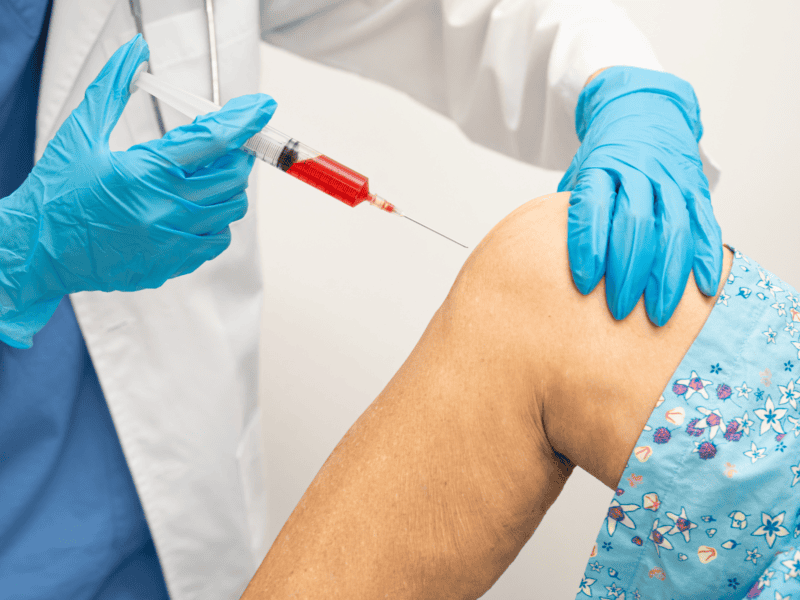
Platelet-Rich Plasma (PRP) is a regenerative treatment derived from your own blood. After a simple blood draw, the sample is spun in a centrifuge to concentrate platelets—cells rich in growth factors that help repair damaged tissue.
This concentrated solution is then injected directly into the knee joint.
How PRP Helps Knee Pain
- Reduces inflammation
- Stimulates tissue repair
- Promotes healing of cartilage and soft tissue
Studies show PRP can provide relief for 6 to 12 months and improve pain and function in knee osteoarthritis patients.
What Is Bone Marrow Concentrate (BMC)?
Bone Marrow Concentrate (BMC), also called BMAC, is a regenerative therapy that involves extracting bone marrow (typically from the pelvis), concentrating it, and injecting it into the knee.
How BMC Works
- Contains stem cells (MSCs)
- Includes growth factors and platelets
- Helps regulate inflammation and healing
PRP vs. BMC: What Does the Research Say?
- PRP often outperforms placebo and hyaluronic acid injections
- PRP may provide longer-lasting relief than steroid injections
- BMC has not been shown to be superior to PRP in clinical trials
- No strong evidence shows BMC regrows cartilage in humans
Key Differences Between PRP and BMC
Procedure Complexity
- PRP: Simple blood draw
- BMC: Bone marrow extraction required
Recovery Time
- PRP: Minimal downtime
- BMC: Longer recovery
Cost
- PRP: More affordable
- BMC: More expensive
Evidence
- PRP: Strong clinical support
- BMC: Limited evidence
Which Treatment Works Best?
For most patients, PRP is the preferred first-line regenerative treatment due to its effectiveness, lower cost, and minimally invasive nature.
BMC may be considered in more advanced or complex cases, but it is not necessarily more effective than PRP.
Is Regenerative Therapy Right for You?
The best treatment depends on your condition, lifestyle, and medical history. A personalized evaluation is essential to determine the most appropriate option.
Final Thoughts
While BMC may sound more advanced, current research shows that PRP therapy offers comparable or better results for most patients with knee pain. Starting with PRP is often the most practical and evidence-based approach.
[gravityform id=1 title=false description=false]
 PRP for Spine Pain and SI Joint Pain: Can Regenerative Medicine Help Disc Tears?